Brim Explorer is a tourism and technology company offering silent, responsible fjord cruises on nature’s terms. Our vision is to be a global pioneer in ocean experiences. By creating experiences that bring us closer to the ocean, we hope that our guests leave with a stronger environmental understanding and engagement than when they came onboard our boats.
- Brim Explorer
- Environmental Policy & Education

Environmental Policy & Education
We believe in protecting and preserving the ocean by sharing its life, vulnerability and majesty.
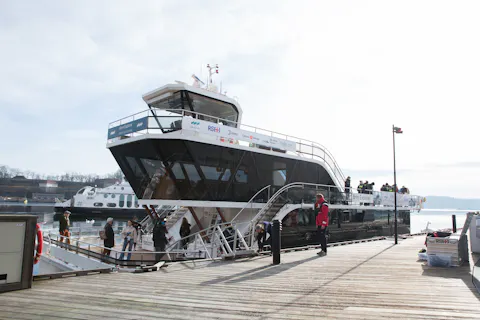
Our Education
At Brim Explorer, we take education about the marine environment to heart. We have a team of educational professionals, marine biologists and researchers with collectively over 100 years of experience in fields, ranging from political science and marine ecology to tourism and teaching. These passionate individuals are responsible for the content we deliver, which forms the backbone of our operations, and provides unforgettable experiences that immerse our guests in nature.
Brim Explorer participates in a number of different projects for education, research and outreach for students, politicians, tourists and businesses alike.

Current Projects
1. Support of Whale and Dolphin Conservation
Brim Explorer supports the work of WDC, Whale and Dolphin Conservation, the leading charity dedicated to the protection of whales and dolphins. We have chosen to collaborate with WDC and their work to stop whaling. Whales are also highly developed mammals with a sense of pain and a complex social structure. Research shows that whales are important for maintaining the ocean’s ecosystems and ability to bind CO2 - and thus counteract climate change. By killing whales, we harm the whales, the ocean - and ourselves.Our guests can donate money to WDC here.

2. Annual whale watching survey
Brim Explorer’s captains and guides document how whale watching is being conducted outside Tromsø throughout the whale watching season. We count the number of vessels, number of orcas, the speed and proximity of vessels and the behaviour of vessels and whales. We present the data for the government, industry and media to get stricter regulation in place ensuring responsible whale watching.
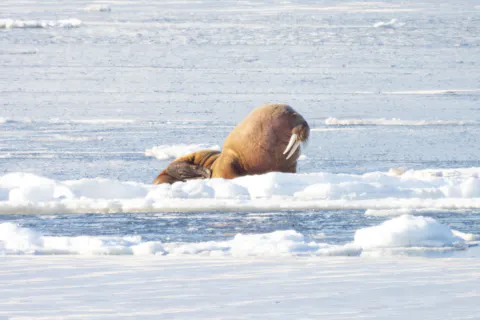
3. Show & Tell together with the university centre in Svalbard (UNIS)
Our collaboration with UNIS is a show & tell project to give our tours more variation and for students to practice to spread their knowledge. The project strengthens our relationship with the locals in Svalbard and the research they do there. Students from UNIS join our tours and present their projects to our guests. By doing this, we learn something new and our tours become even more relevant and exciting.

4. Tree planting combining nature restoration and CO2 capturing and storage
Brim Explorer has entered into a ten-year tree planting partnership with Valþjófsstaðir in Iceland combining nature restoration with CO₂. capturing and storage. Through the partnership, degraded land will be restored, biodiversity strengthened and local ecosystems rebuilt. The project follows Skógarkolefni, the Icelandic Forest Carbon Code, with independent third-party verification and regular evaluation of documented CO₂ capture.

5. Data gathering for Norwegian Polar Institute
We regularly gather data on behalf of Norwegian Polar Institute. As we go out to sea every day we have the possibility to gather data, which a research institution could never afford to finance. This way we contribute to increase understanding, population situation and a essential information about these unique animals in an ever changing arctic environment. We register all marine mammals we observe on our tours and log what animal it is, the size, where we spotted it and its behaviour.
6. Share your research with our guests
Are you a marine or environmental researcher with a project that could help inspire greater awareness and understanding of our oceans and environment? We welcome researchers to join us and share their work with our guests, helping to turn scientific knowledge into meaningful experiences and conversations.
Do you think your research aligns with our goal of creating awareness and inspiring positive change? Get in touch! We are always happy to collaborate on research projects and contribute to shaping a more sustainable future.
Waste management
All our employees are to know the rules and requirements for waste management, preventing oil spill. Detailed information and training material is found in our ISM-system.
On board our boats we sort: regular waste, food, paper, glas, plastic bottles and dangerous waste. This is logged and delivered at a waste station on land. The volume of waste generated on board shall, as far as possible, be reduced to a minimum. When ordering goods we shall consult the supplier and encourage them to use minimum packaging and/or packaging in recyclable materials. The crew shall ensure that all waste generated on board, except hazardous substances, which must be stored separately, must be sorted and stored in dedicated waste containers. Where sorted waste facilities are not available on shore, we shall encourage the harbour to improve their waste handling capabilities. Under no circumstances should waste be thrown overboard. Necessary measures shall be taken to calculate the potential risk to health and safety, as well as the risk of fire associated with stored waste on board. Flammable waste shall be stored in a safe environment and removed as soon as possible. The surroundings of such material shall be kept clean at all times. Waste containers onboard shall be placed so that they do not obstruct evacuation routes.
Purchasing policy
The main principle is to reduce our purchases of non reusable material and always strive to pick the most environmentally friendly choice on the market. We want to prioritise environmentally certified suppliers and products and have a frequent run through of these.
A big part of our purchases are food and drink related for purchase on board. For this purpose we use local suppliers to the degree its possible, and we specifically choose the suppliers with the best environmental profiles. The restaurants we buy food from use locally sourced produce that are in season, and from these suppliers we primarily buy fish and vegetarian. We avoid offering meat to our guests due to the environment.
Marketing material
Our primary attitude for use of marketing material is that it should almost all be digital. When we use material as: Brochures, banners or business cards we will always choose environmentally friendly products and suppliers like Svanemerket or Miljøfyrtårn. The same goes for ads and promotion of our products.
Cleaning
All cleaning products that are used on board are to be environmentally labelled with natural substances to the degree where it is possible (ex vinegar)
Past Projects / Publications and Blog posts
Norway's electric boats powering ahead to reduce impacts on killer whales.
Learn more here.
Future Projects
Contact us here if you are interested in a collaboration within research, education or sustainability:
research@brimexplorer.com

