1. Brim Explorer
  2. Tromsø boat tours
  3. Tromsø - Whale watching from Tromsø - Comfortable and spacious boat
Highlights
  • • More than 95% chance to see orcas, fin or humpback whales

  • • Knowledgeable guides, mostly marine biologists

  • • Ethical whale watching practice

  • • Fast ship, comfortable saloons and spacious outdoor deck

  • • Fully licensed bar with local food & drinks for purchase

Check availability


Tour map and description

Cruise through Arctic waters, surrounded by mountains topped with snow. Experience the Arctic light through the winter. When we arrive around Skjervøy, we keep our eyes peeled for a blow or breach. Once we spot the whales, our captains navigate to a safe distance from the whales where we can observe them.

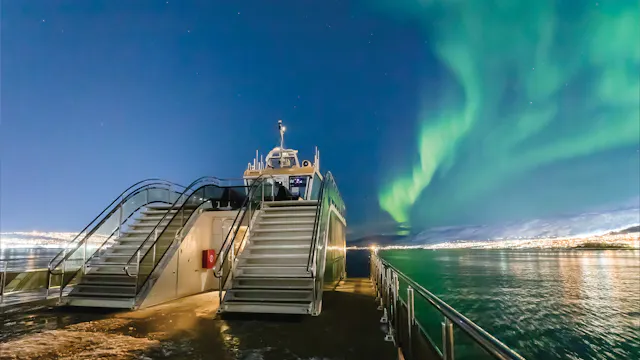
You can watch the whales from the warm saloon with windows, or from one of the outside decks.

SWW Map Tromsø 100
Shawn van Zyl Brim Explorer AFC 7

On the lookout: your journey to the whales

We leave Tromsø in the morning and sail north for around 3 to 3.5 hours, past the Lyngen Alps and Lyngstuva lighthouse to the waters around Skjervøy, where the whales gather to feed on herring. Along the way, our guides share stories about life in the Arctic winter and point out sights from the fjords.

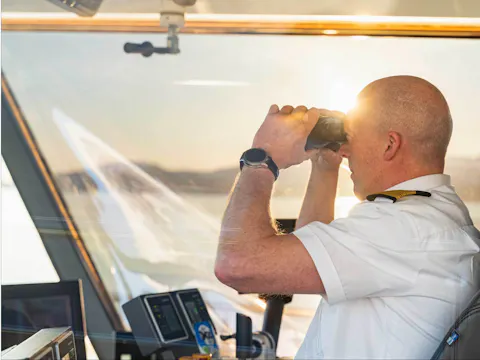
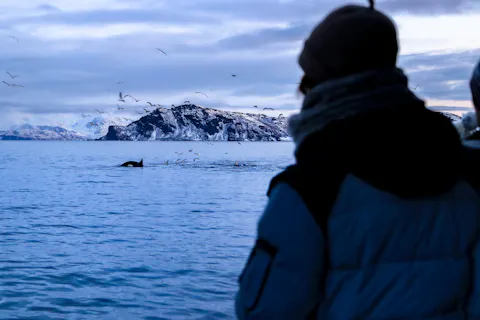
Once we reach the feeding grounds, our captain and guides keep watch from the bridge and decks. The whales move with the herring, so finding them can take time, but our guides know what to look for, from the whale's blow to seabirds gathering over the herring. We spend around 1 to 1.5 hours with the humpbacks, fin whales, sperm whales or orcas before sailing back to Tromsø.

Orca breach 1x1

Whale watching tour with minimal intrusion

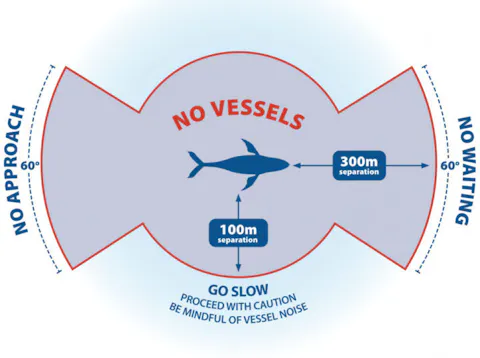
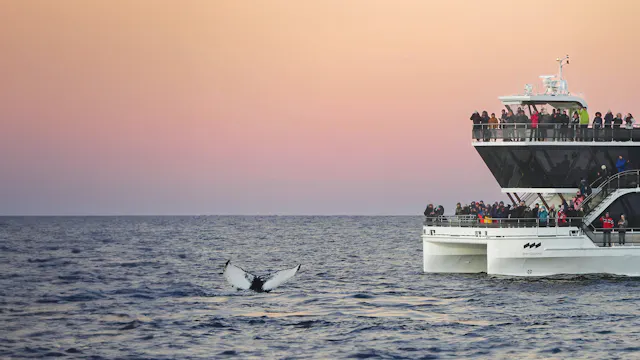
Once the whales have been spotted, we will stop the boats and idle the engines to minimize disturbance to the whales. This keeps noise and vibration in the water to a minimum and gives the whales space to feed undisturbed.

*Please note that the duration of this tour depends on the whales’ location and can range around ±8 hours. The exact season varies year to year but is usually between October and 31 January. Our crew will do their best to find the whales but we can not guarantee whales sightings.

Whale watching approach zone

Respect the whales!

We strive to work towards better and more responsible whale watching tourism. With this, we follow abide by a strict whale watching philosophy, which you can learn more about below.

A7 R3452 Edit

The boat

On this tour you sail on MS Fjordjarl, a modern 39-metre catamaran built for year-round passenger traffic on the Arctic coast. The heated cabin has plenty of space, and the stable hull gives you a smooth ride out to the whales. Note: Bring warm outerwear, including wool layers, a hat and gloves, for your time on deck.

Important booking information

Tour info

  • Time & Duration

    08:30 - 16:30 (± 8 hours)

    Meet at least 15 minutes before departure. Look for the boat with your departure time

  • Meeting point

    Address: Kaigata 6, Tromsø.

    Meet 15 minutes before departure at the pier to the side of Skarven Kro Restaurant in Tromsø

  • Group size (min-max)

    8 - 250

  • Season

    Daily
    01 Nov - 31 Jan 2027

  • Important things to note

    Whales seen on 95% of departures last season

    We generally return around 16:30

    The tour can be wavy at times. We recommend you to take seasickness pills with you

  • Cancellation policy

    More than 48 hours in advance - 100% refund
    Less than 48 hours in advance - No refund

  • Dogs & cats on board

    Dogs and cats are not allowed on this specific tour

Inclusion & facilities

  • Cruise to the area where the whales are

  • Ethical & sustainable whale watching rules

  • English speaking guides

  • Fully licensed bar with drinks for sale

  • Café and fully licensed bar on board selling soup, quiche, cinnamon buns, coffee, tea, beer and wine. Pre-ordering lunch is recommended

    Please note that it is not allowed to bring your own food and beverages on board

  • Free Wi-Fi

  • Toilets

  • Warm indoor saloons

  • Do you require assistance?

    Email us at info@brimexplorer.com if you require assistance with reduced mobility and impaired vision/hearing

Price

  • Adult (18+)

    1,890 NOK

  • Youth (12-17)

    1,417.50 NOK

  • Student

    1,417.50 NOK

  • Child (3-11)

    945 NOK

  • Infant (0-2)

    Free

The migrating herring controls the whale watching season

Whales have come to Tromsø for years to feed. It is a crucial time for the whales as the whales intake much of their yearly required nutrition in the short 3-4 months of their stay. This builds a thick layer of fat, which is the whales 'winter fur'. They depend on this reserve of energy for much of the year. Their favourite snack is herring, due to its high-fat content. The location of the whales (and therefore the area where we go for whale watching), depends on where the herring schools are. The herring themselves migrate over Norway. To spawn in one location and eat in another, but not always do the herring go to the same fjord, and so the location of the whale's changes over the years.

It has a high-fat content, especially when it migrates to the Norwegian coast to spawn in winter and spring. Whales depend on eating up to a good fat reserve, and building a thick layer of fat under the skin, which is marine mammals' "winter fur". Therefore, this period is important for them to survive through an otherwise lean winter.

Read more +

Tips and tricks for whale watching

In order to be successful at whale watching, we use a number of methods and tricks to find the whales. The most famous is probably to watch the whale blow. This is the sea spray that the whale blows up over the water crust when the whale comes to the surface to breathe. For the trained eye, you can also determine the species of whale based on how the spray looks. For the trained nose, you can even distinguish the species of a whale by the smell of their blow! More commonly though, is to recognise if it is a Fin whale, sperm whale, humpback whale or an Orca by the dorsal fin. The killer whale (Orca), has a prominent black fin that is easily recognisable, while the Humpback whale has a smaller dorsal fin further back on the body. 

If the weather is quiet, you can sometimes even hear the sound of the blow. Weirdly enough, it sounds similar to the sound of a person blowing water out of their mouth.

Another, easier way of spotting where whales might be, is the presence of birds such as the seagulls. They feed on the herring that are pushed to the surface by the whales working together to feed. Since herring is also a common source of food for us, we work together with the herring fishing boats to gather information on where the whales have been spotted most recently. 

Read more +

Experience the polar night sky

On our journey to and from the whales' feeding area, we will pass through beautiful landscapes, filled with mountains & fjords. Much of the whale watching season corresponds with 'Polar night', a unique period of the year above the Arctic Circle when the sun does not rise above the horizon. This sometimes brings unique skies with colours of blue, pink and purple. While the sun will not rise, it won't be completely dark as the light still makes its way around the curve of the earth. Especially when the sun is 'at its highest', the exact time we plan to be surrounded by Humpbacks, Fin, Sperm whales and/or Orcas.

Read more +

Facts about the whales in Tromsø

Humpback Whale (Megaptera Novaeangliae)

Humpback whales belong to the Rorquals (Balaenopteridae) family, which are the largest baleen whales. It is therefore related to the blue whale, the world's largest animal. With an average length of 14 meters and a weight of about 60.000 kilograms, the humpback whale is a giant to be reckoned with, in the waters of Tromsø.

The humpback whale can get up to 50 years old. Its tail fin is unique to each individual with distinct colour patterns and protrusions on the tip (similar to human fingerprints), making it possible to identify each humpback whale by its fin. 

The humpback whale is known for its clever ways of catching prey. The "bubble net" method is used when several humpback whales work together to catch shoal fish, such as herring. Some humpback whales will blow air bubbles underwater to fence in the fish in the bubble net, which allows the other whales to gun up from below and take a big bite. In return, this gives us a view of life above water.

Read more +

Killer Whale or Orca (Orcinus Orca)

The Orca, or killer whale, is actually not a whale, but the world's largest dolphin. It is often mistaken for a whale due to its name, which was wrongly translated from Latin, to 'killer whale', instead of 'whale killer'. 

The whale killer makes true to its name and reigns at the top of the food chain in the sea with its scary teeth. It has an average length of 8-9 meters, weighs 3 to 5.000 kilogram, and can get very old. The 'granny', an orca on the west coast of North America was estimated to be 105 years old(1) at his death in 2016. But life expectancy is between 30-90 years. The males are largest, but still significantly smaller than the humpback whale. However, its strength lies in its numbers. The whale killer is a very social and intelligent whale and hunts in larger matrilineal flocks, led by the oldest female. It specialised in its hunting methods based on its prey and the part of the world. In Northern Norway, the whale killer is known for its 'carousel hunt' where the orcas herd the herring school together with other orcas in a 'carousel'. Then they scare the herring with sound and blows from the fail that makes the fish paralysed/faint.

While the Orca is known to hunt whales, it is 'rather lazy than tired' and will go for easier prey such as herring instead of going through the effort of hunting down a whale.

Read more +

Frequently asked questions about whale watching

How long are we with the whales?

How do you know where to find the whales?

Can you see whales on every tour?

When does the whale watching season end?

How long does the whale watching tour from Tromsø take?

What if the weather is bad?

Do you have rib boats?

Can I bring food?

How many whales can be seen at most on a single trip?

What is the best time for whale watching in Tromso?

We are travelling with children, is whale watching in Tromsø a family-friendly tour?

Which whales are most common to see on whale safaris in Tromsø?

Do we get private seats?

Is it possible to arrange private whale watching charter cruises?

Is there a minimum number of participants for the tour?

Will I get seasick?

Where can I park in Tromsø?

Whale watching from Tromsø on MS Fjordjarl

Check availability for whale watching in Tromsø

Join us whale watching this winter! The bright orange "Book this trip" button has followed you all the way down this page, ready to be clicked. MS Fjordjarl is fast, stable and comfortable, with heated saloons and outdoor decks that give you a good view of the whales. Spend the short hours of Arctic daylight with orcas, humpbacks, fin whales and sperm whales.